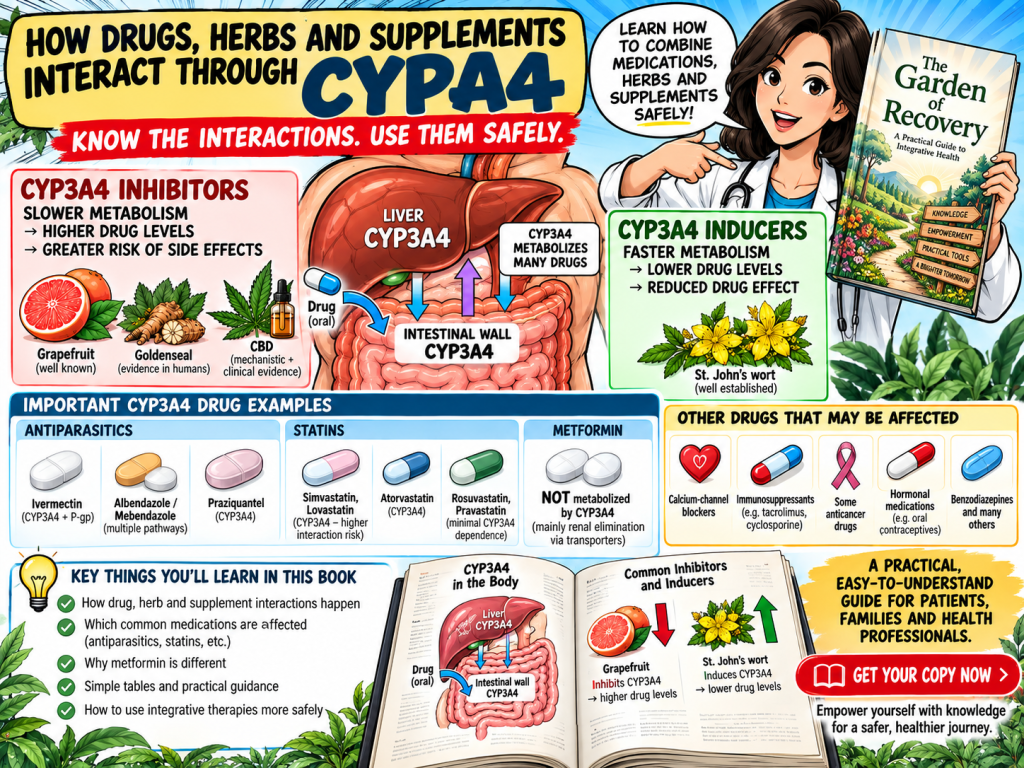
CYP3A4: Why Drug–Herb Interactions Matter
When patients combine prescription medicines, herbs, supplements and repurposed drugs, one question matters:
Can one treatment change the way another is metabolized?
One of the key systems involved is CYP3A4, an enzyme found mainly in the liver and intestinal wall.
The simple rule
CYP3A4 inhibition
→ slower drug breakdown
→ potentially higher drug levels
CYP3A4 induction
→ faster drug breakdown
→ potentially lower drug levels
Common examples
Grapefruit can inhibit intestinal CYP3A4 and increase exposure to susceptible drugs.
St. John’s wort induces CYP3A4 and P-glycoprotein and can reduce levels of several medications.
Berberine, goldenseal and CBD can affect CYP enzymes and/or transporters, although the clinical importance varies by drug and dose.
What about antiparasitics?
Some commonly used antiparasitic medicines also have important metabolic pathways:
- Ivermectin — CYP3A4 + P-glycoprotein
- Praziquantel — CYP3A4
- Albendazole / mebendazole — multiple metabolic pathways
This means that other medicines or supplements can potentially alter their exposure.
Statins are another good example
Simvastatin and lovastatin are highly CYP3A4-dependent.
Atorvastatin is also metabolized through CYP3A4.
By contrast, rosuvastatin and pravastatin have much less dependence on CYP3A4.
So even within one drug class, pharmacokinetics can be very different.
And metformin?
Metformin is an important exception.
Metformin is not primarily metabolized by CYP3A4.
It is eliminated largely unchanged by the kidneys and involves OCT and MATE transporters.
So for metformin, renal function and transporter interactions may be more relevant than CYP3A4.
Think beyond CYP3A4
Drug interactions involve a network:
CYP3A4 • CYP2D6 • CYP2C9 • CYP2C19 • P-gp • OATP • OCT • MATE • UGT • renal clearance
And remember:
An interaction demonstrated in a laboratory does not automatically mean it is clinically significant in humans.
The strongest evidence comes from human pharmacokinetic studies and clinical outcomes.
The takeaway
Don’t simply ask:
“Is this herb safe with this drug?”
Ask:
“How is this drug metabolized or eliminated—and could anything else in the regimen change that?”
That systems-based approach is central to the philosophy behind The Garden of Recovery: A Practical Guide to Integrative Health—bringing conventional medicine, nutrition and complementary therapies together while keeping pharmacology, evidence and safety in the picture.


Leave a comment