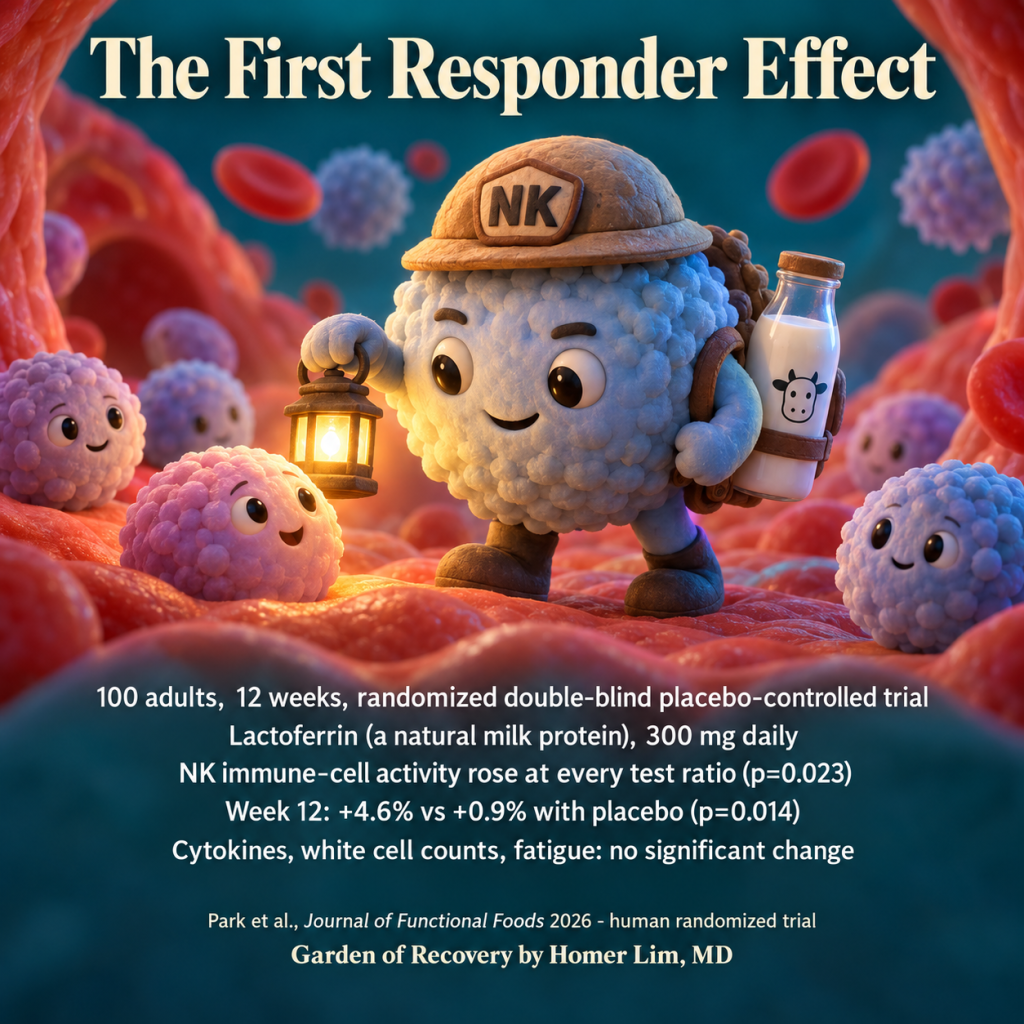
Your immune system has first responders. Natural killer cells, or NK cells, patrol your body looking for cells that look wrong: virus-infected cells, and cells starting down the road to cancer. When NK activity is strong, suspicious cells get flagged early.
A new study in the Journal of Functional Foods asked a simple question: can a natural milk protein, lactoferrin, make these first responders more active?
It was a real test. One hundred adults were randomly assigned to take 300 mg of lactoferrin or a look-alike placebo every day for 12 weeks, double-blind, so neither participants nor researchers knew who got what. This is the strongest kind of evidence in nutrition research.
The result: NK cell activity rose significantly in the lactoferrin group at every level the researchers tested, while the placebo group barely moved. After 12 weeks, the change measured about +4.6% against +0.9% with placebo at the toughest test ratio.
Just as important is what did not change. Inflammatory markers, white blood cell counts and fatigue scores were no different between groups. The researchers themselves call this a biological response, not proof of clinical benefit. Nobody should read this study as “lactoferrin prevents cancer” or “lactoferrin stops infections.”
One intriguing hint: repeat infections showed up only in the placebo group. The trial was not designed to prove that, so it stays a hint, not a conclusion.
Lactoferrin is not exotic. It is found in milk and in the mucus lining your airways and gut. What this study adds is human evidence, from a proper randomized trial, that taking it can nudge one arm of that system upward.
The practical takeaway is not “go buy lactoferrin.” It is that immune support is measurable. When you hear a claim about any supplement, ask the questions this study answers: Was it tested in people? Was there a placebo group? What exactly changed, and what did not?
That habit of asking is worth more than any single supplement.
Educational only, not medical advice. If you are in active treatment, bring any supplement question to your oncology team first.
From my book, Garden of Recovery: a plain-language guide to understanding cancer and your choices. Learn more at gardenofrecovery.com.


Leave a Reply